
What is diagnostic laparoscopy?

Diagnostic laparoscopy allows your doctor to make a definitive diagnosis of many gynecological problems, including endometriosis, uterine fibroids, congenital uterine abnormalities, cysts, adhesions and ectopic pregnancy. If there is pain in the lower abdomen or pelvic area, infection or other symptoms of disease, your doctor may recommend diagnostic laparoscopy to reach a clear diagnosis.
Diagnostic laparoscopy may also be used to investigate the cause of a woman’s infertility.
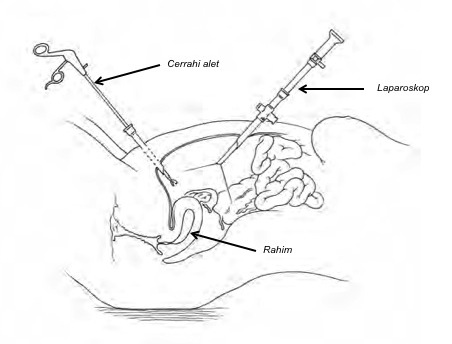
The procedure is usually performed after the menstrual period, under general anaesthesia. After anaesthesia, the abdomen is filled with carbon dioxide gas through a needle. The gas lifts the abdominal wall away from the internal organs, allowing the laparoscope to enter the abdominal cavity easily and safely without damaging the organs. The laparoscope is usually inserted through a small incision in the navel.
With the laparoscope, your doctor examines the uterus, fallopian tubes and ovaries. A second instrument is usually inserted through a small incision just above the pubic hairline so that the pelvic organs can be examined in more detail. If needed, dye can be injected into the uterus or fallopian tubes to check whether the tubes are open. If an abnormality is found, the diagnostic laparoscopy can be converted into operative laparoscopy.
What is operative laparoscopy?
Many gynecological problems can be treated safely with operative laparoscopy. During the procedure, additional instruments (probes, surgical scissors, forceps, lasers, suture materials, etc.) can be inserted through small abdominal incisions. Conditions that can be treated this way include releasing adhesions around the ovaries and/or fallopian tubes, opening blocked fallopian tubes, removing ovarian cysts and treating ectopic pregnancy. Endometriosis in the uterus, ovaries and other areas can be treated by removing the affected tissue. Diseased ovaries can also be removed laparoscopically as part of a hysterectomy.
Recovery after laparoscopy
After laparoscopic surgery you may have tenderness and bruising around the navel and abdomen. The gas used to inflate the abdomen can cause discomfort in the shoulders and chest, and the anaesthesia may cause nausea and dizziness. Most people return to daily work and home life within a few days. If you have severe abdominal pain, vomiting, fever, discharge or bleeding from the stitches, contact your doctor immediately.